
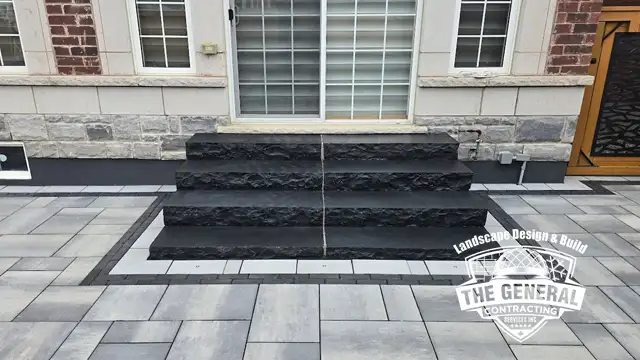
Summary: Excavation depth for an interlock driveway must accommodate the pavers, bedding, compacted aggregate base, and drainage needs, guided by soil conditions, vehicle loads, and paver thickness. Solid base preparation, not surface colour or pattern, determines long-term driveway performance.
Professional interlocking installation in Toronto starts by evaluating the ground beneath the proposed driveway. A contractor should inspect the soil, existing pavement, slopes, drainage routes, garage height, curbs, and adjoining walkways before deciding how much material to remove. There is no single excavation number that is correct for every property.
Understand What Fits Below the Pavers
An interlock system includes more than the visible paving stones. Beneath them is a thin, even bedding layer, a substantial compacted aggregate base, and the prepared subgrade. Edge restraints, drainage details, and geotextile may also form part of the assembly depending on the property and design.
Excavation has to make room for all those layers while leaving the finished pavers at the correct elevation. If the dig is too shallow, the base may not have enough structural capacity. If it is unnecessarily deep, the project requires more removal, aggregate, labour, and compaction without automatically producing a better driveway.
Paver thickness is part of the calculation, but it should not be considered in isolation. The surface, bedding, and base work as one system, and the excavation depth must reflect their combined profile. Contractors should confirm the selected product before final grading because changing paver thickness late can affect transitions and drainage.
| Layer | Purpose |
|---|---|
| Subgrade | Prepared native or stabilized soil |
| Aggregate base | Compacted structural support |
| Bedding layer | Thin, even layer under pavers |
| Pavers | Visible driving surface |
| Edge restraints | Hold pavers in place |
| Geotextile | Optional separation layer |
Let Soil Conditions Guide Excavation
Firm, well-draining native soil behaves differently from clay, loose fill, or soil disturbed by previous construction. Weak or water-sensitive material may need to be removed farther until a stable subgrade is reached. Soft pockets should not simply be hidden beneath aggregate because they can contribute to settlement and uneven pavers later.
Toronto and GTA properties can vary considerably, even within the same neighbourhood. The history of the lot matters as well: a former garden bed, utility trench, recently filled area, or old driveway patch can create inconsistent support. A contractor may use proof rolling, hand probing, or excavation observations to identify areas requiring additional attention.
Excavated soil should be reviewed continuously instead of assuming conditions will remain uniform from the curb to the garage. Changes in colour, moisture, texture, or resistance can reveal fill and disturbed zones. Addressing those variations during excavation is more reliable than discovering settlement after the driveway has been completed.
Account for Vehicle Loads and Daily Use
A driveway carries repeated loads that a backyard patio does not. Passenger vehicles, delivery trucks, turning wheels, and braking near the garage place stress on the paver system. The base must distribute those loads and resist movement through seasonal changes.
Driveways used by heavier vehicles or built over weaker soil generally need a more robust design. Width, parking patterns, and confined edges also influence performance. Instead of treating the whole property like a light pedestrian surface, the assembly should be designed for the most demanding normal use expected in that area.
Build the Aggregate Base in Compact Lifts
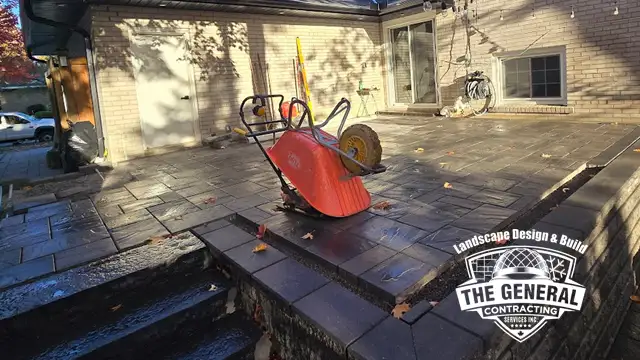
Base thickness alone does not guarantee stability. Aggregate should be installed in manageable layers and compacted thoroughly before the next layer is placed. Adding a large depth at once can leave lower material insufficiently compacted, even when the surface appears firm.
Moisture content, aggregate type, equipment size, and lift thickness all affect compaction. Corners and edges deserve special care because large compactors may not reach them effectively. The finished base should be dense, even, and shaped to the required grade before bedding material is added.
Quality control includes checking elevations throughout the work, not only at the end. String lines, levels, and laser measurements can confirm the base follows the intended plane and leaves consistent room for bedding and pavers. Correcting a low area with extra loose bedding is not equivalent to rebuilding the compacted base to grade.
Documented measurements also make final transitions and drainage slopes easier to verify before paving begins.
Preserve Drainage and Finished Elevations
The driveway must direct water away from the house and avoid trapping it near the garage, foundation, or neighbouring property. Excavation planning establishes room for the base while preserving a useful slope across the finished surface. Drainage should be considered before the first load of aggregate arrives.
Door thresholds, garage slabs, sidewalks, curbs, catch basins, and existing landscaping create fixed elevations that the new work must meet. When those points leave little room for a suitable base, the design may need adjustment rather than forcing the pavers into an unsuitable grade. The related article on sloped yards and drainage problems explains why water management should be treated as part of the overall landscape.
Use Separation and Reinforcement Where Appropriate
Geotextile can help separate aggregate from certain subgrade soils, limiting contamination and preserving the function of the base. It is not a substitute for removing unstable material or compacting correctly. Its value depends on soil conditions and the intended design.
Some sites may require additional reinforcement, drainage stone, or other engineered details. Those choices should respond to an observed condition rather than being added as generic upgrades. A clear proposal should describe the planned excavation, base materials, compaction process, and any site-specific measures so homeowners can compare more than the final paver price.
Recognize Signs of Poor Base Preparation
Early warning signs can include rocking pavers, spreading joints, low spots that hold water, sinking along tire paths, and separation at curbs or garage edges. A few isolated pavers can sometimes be reset, but repeated settlement often points to a deeper issue with support, drainage, or edge restraint.
Surface repairs will not permanently correct a failing foundation. Before replacing pavers or adding joint material, determine why movement occurred. Homeowners researching budgets can review the existing guide to interlock driveway costs in Toronto, including the factors that influence proper excavation and base work.
Ask prospective contractors how they handle unsuitable soil, compact lifts, drainage, edge restraint, and disposal of excavated material. These details make quotations easier to compare and reduce uncertainty about what is included. A lower price based on less excavation or fewer base materials may represent a different scope rather than a better value.
Base depth standards do not change at the city border. Whether we are excavating in the core or building an interlock driveway in North York, the gravel depths above are the minimum we work to on every project.
The General Contracting Services Inc. Invitation
Choose The General Contracting Services Inc. To discuss how deep to dig for interlock driveway construction on your property, call (416) 936-3335 and contact us for a free quote with properly planned excavation, grading, and base preparation.