
Summary: Water should move away from your house instead of collecting beside the foundation. The most effective solutions usually involve correcting the grade around the home, extending downspouts, controlling runoff from patios and driveways, and adding swales, catch basins, French drains, or drainage pipe when necessary. The right solution depends on where the water is coming from and where it can safely be discharged.
Water collecting around a house foundation can lead to more than an annoying puddle. Saturated soil beside the home can contribute to basement moisture, erosion, settlement, damaged landscaping, and problems with nearby patios, walkways, and retaining walls.
The key is not simply getting rid of standing water. A good drainage plan determines where the water originates, how it travels across the property, and where it can safely go.
As a yard drainage service, here's what we've learned is a quick way to identify some of the most common foundation drainage problems:
| What You Notice | Likely Cause | Common Solution | Priority |
|---|---|---|---|
| Water pooling directly beside the house | Poor or negative grading | Regrade soil away from foundation | High |
| Large amounts of water below a downspout | Roof runoff concentrated in one area | Extend or redirect downspout | High |
| Water crossing the lawn toward the house | Property slope or surface runoff | Swale or regrading | Medium to High |
| Persistently wet soil beside the foundation | Subsurface water or trapped drainage | French drain or drainage system | High |
Find Out Where the Water Is Coming From
Before installing a drain, adding soil, or digging a trench, determine where the water actually originates. The wet area beside the foundation may only be the final collection point.
Watch the property during a steady rainfall if possible. Look at the direction water moves across the lawn, driveway, walkways, patios, garden beds, and neighbouring grades. Check each downspout and note where the water goes after it leaves the pipe.
Water may be reaching the foundation from several sources at the same time. Roof runoff may combine with a poorly graded side yard, for example, creating a much larger problem than either issue would cause independently.
Pay particular attention to:
- Downspouts terminating close to the house
- Low areas immediately beside the foundation
- Soil that has settled over time
- Patios or walkways sloping toward the house
- Water coming from higher sections of the yard
- Runoff travelling around retaining walls
- Sump pump discharge locations
- Water entering window wells
Taking photos or a short video while it rains can be useful because drainage problems are often much harder to understand once the property dries.
Foundation drainage is also connected to the way water behaves across the rest of the property. Our guide on how to fix yard drainage problems on Toronto properties takes a broader look at diagnosing standing water, soggy lawns, runoff, and other drainage issues.
Correct the Grade Around the Foundation
One of the simplest principles of residential drainage is that the ground around the house should encourage water to move away from the foundation.
Problems develop when the opposite occurs.
Soil can settle beside a house over time and create a shallow depression. Landscaping renovations can also change elevations. Raised garden beds, new sod, walkways, patios, retaining walls, and driveway work can unintentionally create areas where water flows back toward the home.
Correcting the grade may involve adding and compacting appropriate soil, removing high areas farther from the house, reshaping sections of lawn, or changing the elevation of nearby landscaping.
Simply dumping loose topsoil into a low area is not always enough. Loose material can settle again, and raising one section without considering the surrounding property may send the water somewhere else.
A successful grading plan creates a continuous route.
Water should move away from the foundation and continue toward an appropriate lower area rather than travelling a short distance and collecting in another depression.
Existing doors, basement windows, window wells, siding, walkways, and other fixed elevations also need to be considered. Grading is therefore less about making one spot higher and more about shaping the surrounding property so water has somewhere useful to go.
Extend Downspouts Away From the House
Your roof collects a significant amount of rainwater and concentrates it into only a handful of downspouts.
When a downspout terminates beside the house, all of that water is released into a small area directly beside the foundation.
Extending the downspout can therefore be one of the easiest and most effective drainage improvements.
For some homes, an above-ground extension is sufficient. The extension should carry water far enough away that it continues travelling away from the house rather than soaking into a low area that slopes back toward the foundation.
Other properties may benefit from underground solid drainage pipe.
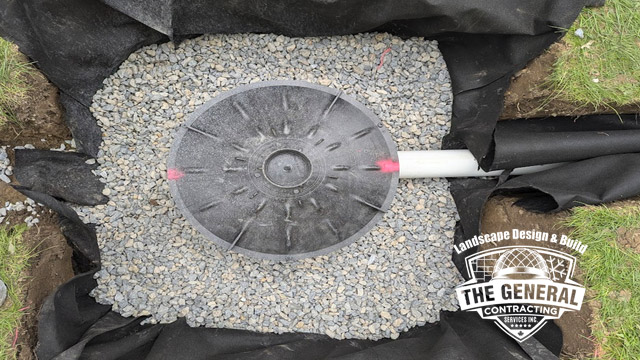
A buried downspout line can move roof runoff across the property while keeping the landscaping cleaner. However, the pipe still needs a suitable outlet and enough slope to function properly.
Avoid assuming that burying the pipe automatically solves the problem. Water entering an underground system still needs somewhere to go.
Maintenance should also be considered. Leaves, roofing debris, and sediment can eventually enter drainage lines, so the system should be designed with reasonable access for inspection and cleaning.
Most importantly, concentrated roof runoff should not be released into perforated drainage pipe directly beside the foundation. Solid pipe is generally used when the goal is transporting water from one location to another without intentionally releasing it along the route.
Use Swales and Surface Drainage to Redirect Runoff
Not every water problem requires underground drainage.
Sometimes the best solution is simply giving surface water a better route across the property.
A swale is a shallow, gradually shaped channel that directs runoff toward a lower area. It can be incorporated into a lawn or landscape without looking like a traditional ditch.
Swales can be particularly useful when water is travelling toward the house from a higher section of the yard.
Instead of allowing runoff to reach the foundation, the swale intercepts the water and directs it around the house.
Surface grading can also help guide water between houses, around patios, or toward other suitable drainage areas.
The important part is making sure the drainage route continues.
Creating a swale that sends water ten feet away before ending in another low spot simply relocates the problem.
Sloped properties can become more complicated when soil needs to be held in place while runoff is redirected. Retaining walls may become part of the solution, but the wall itself must also be properly drained. The article on interlocking walkways with retaining walls for Toronto homes explains how grading, retaining walls, walkways, and drainage need to work together.
Install a French Drain or Catch Basin When Surface Drainage Is Not Enough
Grading and downspout management should usually be evaluated before automatically deciding that an underground drain is required.
However, some properties need additional drainage infrastructure.
A catch basin collects water flowing across the surface. It is often installed at a low point where runoff naturally gathers. The basin connects to solid drainage pipe that carries the collected water toward an appropriate discharge location.
A French drain serves a different purpose.
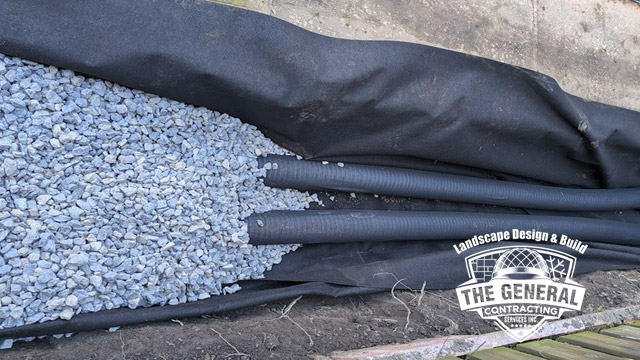
French drains typically use perforated pipe surrounded by drainage stone to collect water moving through saturated soil. They can be useful where subsurface moisture remains a problem even after surface drainage has been addressed.
A channel or trench drain can be useful where water crosses a hard surface, such as a driveway, patio, or walkway.
Choosing the right drain depends on the type of water being managed.
A catch basin will not necessarily solve groundwater moving through saturated soil, and a French drain is not automatically the best way to capture large volumes of surface runoff.
Every drainage system also needs an outlet.
Installing hundreds of feet of drainage pipe does little good if the collected water has nowhere to go. Elevations, pipe slope, soil conditions, discharge location, maintenance access, and local requirements should all be considered before excavation begins.
Make Sure Patios, Walkways and Driveways Drain Away From the Foundation
Hardscaping can dramatically change how water moves around a home.
Grass and planting areas can absorb some rainfall. Interlocking pavers, concrete, asphalt, and other hard surfaces collect runoff and move it much more quickly.
A patio that slopes toward the house can therefore send a large amount of water directly toward the foundation during a heavy storm.
Walkways beside the home can create the same problem.
Even when the surface itself looks level, small elevation differences can determine which direction water travels. Proper drainage needs to be established before the base and finished surface are installed.
Our guide to interlocking brick patio ideas for Toronto backyards discusses why drainage should be incorporated into patio design alongside layout, base preparation, borders, and other features.
Existing hardscaping should also be inspected when foundation water problems suddenly appear.
Look for:
- Pavers that have settled toward the house
- Concrete directing water toward foundation walls
- Low areas between the patio and house
- Water trapped between retaining walls and hardscape
- Driveway runoff travelling toward the garage or foundation
- Walkways blocking the natural drainage route
Correcting the surrounding hardscape may sometimes be more effective than installing another drain.
The goal is to control water before it reaches the foundation instead of continuously trying to collect it once it gets there.
Know When the Drainage Problem Needs Professional Help
Some drainage problems can be improved with a downspout extension or minor grading correction. Others involve the elevations of the entire property.
Professional assessment becomes especially valuable when water repeatedly collects beside the foundation, moisture appears inside the basement, large sections of the yard remain saturated, erosion is occurring, or previous drainage repairs have failed.
A contractor can measure elevations instead of relying only on what appears level to the eye.
The assessment should consider the complete system:
- Where is the water coming from?
- How is it currently travelling?
- Why is it collecting beside the house?
- Where can it safely be redirected?
- What needs to change to create a continuous drainage route?
The answer may involve several improvements rather than one large drainage system.
For example, a property might require a downspout extension, minor regrading, a catch basin at a low point, and adjustments to an existing patio. Addressing only one part may reduce the problem without actually solving it.
Drainage work should also be considered before spending heavily on finished landscaping. Excavating trenches or changing elevations after new sod, gardens, patios, or walkways have already been installed can create unnecessary additional work.
Our landscaping budget guide for Toronto and the GTA explains why grading, drainage, and structural hardscaping should generally be considered early when planning a larger landscaping project.
A good drainage plan protects more than the basement. It protects the lawn, gardens, patios, walkways, retaining walls, and other investments surrounding the home.
The General Contracting Services Inc Invitation
Water should have a planned route around your property rather than finding its own path toward your foundation.
The General Contracting Services Inc. provides professional grading and drainage solutions for homeowners throughout Toronto, Mississauga, Etobicoke, Brampton, Vaughan, North York, Oakville, Milton, Halton Hills, and surrounding GTA communities.
Our team can assess how water is moving across your property, identify grading and runoff problems, and recommend a drainage solution suited to the site. Depending on the property, the solution may include regrading, swales, catch basins, French drains, downspout drainage, hardscape corrections, or a combination of methods.
If water is pooling around your foundation or repeatedly creating wet areas around your home, contact The General Contracting Services Inc. or call (416) 936-3335 for a free quote and a drainage plan designed around your property.